The FCC, First Amendment, and Censorship.
Apologies for the 24-hour delay in my missive to you this week. In case you didn’t see it on my Instagram stories, my parents were in town this past weekend and didn’t leave until yesterday. As a result, I chose to maximize every minute they were here with me, figuring that you would understand. 😉
It was especially lovely to spend Father’s Day with my dad, who is now 82 years young! We began the morning by letting him show me his breakfast (which consists of broccoli, cherry tomatoes, carrots, cabbage, gochujang, and watery oatmeal), followed by an hour at the driving range (my father is obsessed with golf). We came back home to catch some World Cup (my father is also obsessed with soccer) and then went all the way into Koreatown for some naengmyeon (Daddy’s favorite dish in all the world). After much digging, I’d managed to find an authentic naengmyeon house that specializes in North Korean noodles (my father is from North Korea) that had two vegan options, along with vegan bibimbap (for Anthony). It was my first time ordering naengmyeon at a restaurant since going vegan! It was excellent, though, the homemade version I have in my first book is just as good (in my humble opinion….!).
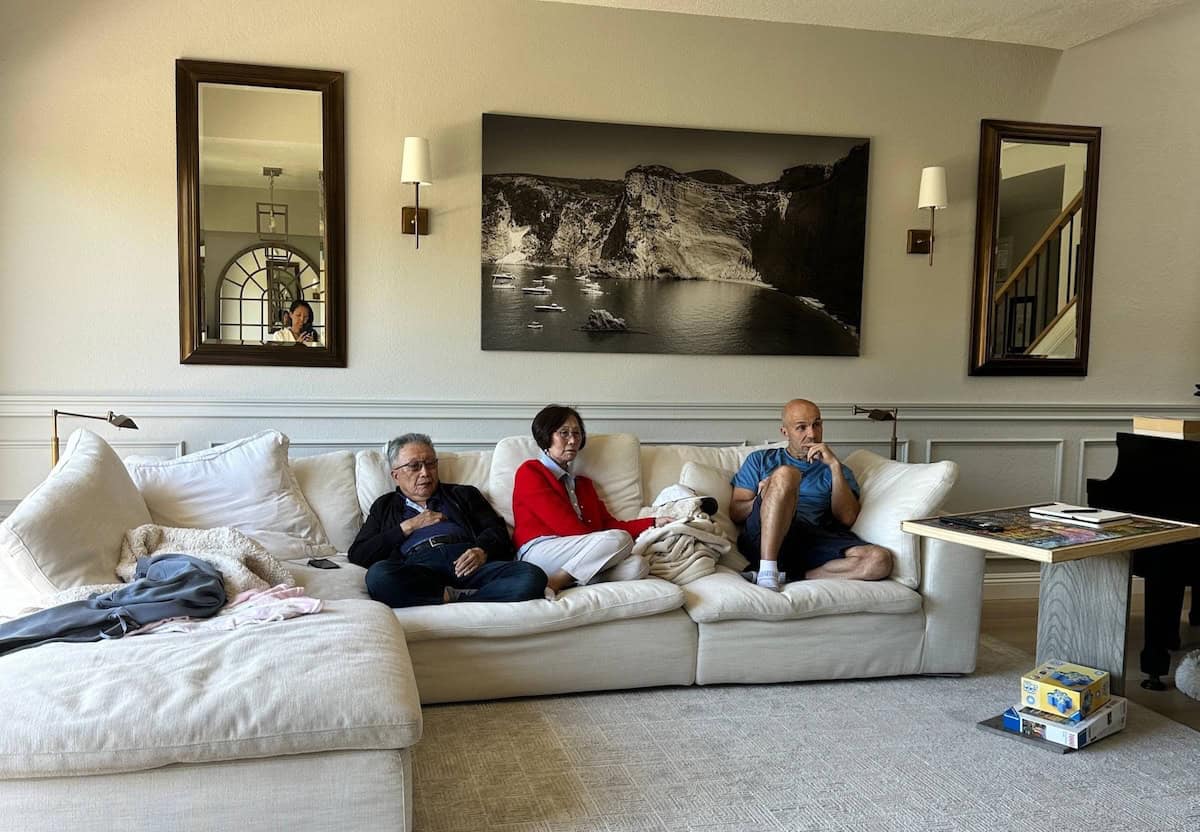
Both my parents ate more food than either Anthony or I could recall in recent memory, which, of course, made me so happy. We spent the rest of the day loafing on the couch together watching more soccer. I also managed to whip up a homemade strawberry cheesecake (vegan, of course), as well as a yummy Korean dinner using recipes from my cookbooks–braised tofu, vegetable jeon, vegan galbi, sauteed zucchini. Despite feasting at lunch, they loved my food so much, they kept eating and eating and eating. They especially loved my vegetable jeon (you can find it in Homemade). “These are excellent,” my mother praised, which means so much coming from her!!
They were equally impressed with my cheesecake–so much so, that my mother asked me for the recipe the following day, right before getting into her Uber for the airport. I didn’t have one specifically, but I shared the Peach Cheesecake recipe on which it’s based. Don’t worry, I’ll make a proper recipe out of it soon, I promise!
Not all of my weekly essay make it onto the website. Subscribe to get my Tuesday Musings delivered directly to your inbox.
Tuesday Musings
only in your inbox
After they left, I spent a few minutes scrolling through my newsfeed and stumbled on an interesting article regarding The View. The Barbara Walters created “chat show” was appealing to its watchers to “fight the FCC” which, according to the show’s hosts, was violating the broadcaster’s First Amendment rights. I knew that The View had come under scrutiny several months ago when the ladies openly criticized Trump, as well as the FCC’s entanglement with Jimmy Kimmel, but I thought the urgency had passed into oblivion. Apparently, I was wrong.
The article led me down a deep, deep rabbit hole regarding the FCC’s history with the licensing renewal process, the First Amendment, censorship, and what all of this portends for free speech. The following are a few things I thought you might find interesting, based upon what turned into several hours of research.
[Oh, and btw, if you’re new here and wondering why I’m talking about the law, I’m also a lawyer with over 20 years of experience. I’m a feminist, pro-democracy, and believe Black lives matter. I detest homophobia, transphobia, misogyny, and racism more than I love my kimchi recipe (and that’s saying a lot). I love animals and, as a result, do my best everyday not to exploit them to the best of my abilities. There are a whole host of other political, social, philosophical beliefs I carry in my heart, but this disclaimer is already getting too long. I’m not saying any of these things to be confrontational. I just believe in laying my cards out directly, so that you can make your choices accordingly and forestall any impulse to send me messages you might regret (I read every reply to my weekly emails). I value my place in your inbox, but not at the cost of my self-respect. If you want “just recipes,” you can change your email options below! And now, without further ado…]
Why did The View publish an SOS?
Put simply, the FCC is threatening to revoke ABC’s licenses. Specifically, the FCC has subjected eight (8) of ABC’s broadcasting licenses to an “early renewal” process, that forces the broadcasters through an investigation proceeding (prematurely) that may ultimately conclude with revocation of those licenses.
What happens if the licenses are revoked?
The good news is that you’ll most likely still be able to watch Kimmel’s scathing monologues and Whoopi Goldberg pop off at this or that (I mean, it’s the best part of the show!). Why is that? Because these shows are part of ABC’s national programming, which means they’re pushed out to its full network of 200+ broadcasters–not just these 8 that have come under review. Moreover, even if the worst were to happen and the licenses were revoked, it’s likely that ownership of these licenses would simply be transferred to a new owner, one who would probably continue to operate as an ABC-affiliated broadcaster. Finally, even if the new owner either refused to air Disney programming (which it could) or Disney refused to make it an affiliate (which it could), you could still watch Kimmel and The View via streaming.
Then what’s the big deal?
There are really two big deals worth noting:
(a) Local Programming. These licenses will have a direct impact on certain local programming in some of the largest metropolitan areas of the country: Los Angeles (where I live), Chicago (where my parents live), New York City, Philadelphia, Fresno, Houston, Raleigh-Durham, and San Francisco. The newsrooms and their anchors in these cities belong to Disney, and therefore, a revocation of the licenses attached to these cities will mean a near total overhaul of the local news casting. License revocation will impact what they choose to cover, who’s doing the covering, and how well they cover the news.
It will also mean local community-centric programming (emergency alerts, Amber alerts, etc.) will no longer enjoy the robust resources of a massive institution like Disney. Whether or not you like Disney (they have a somewhat checkered past), as someone who lives in “wildfire city,” it’s nice knowing that the local emergency programming has the heft of one of the largest broadcasting conglomerates on the planet.
(b) Chilling Effect. These 8 licenses are extraordinarily valuable to Disney and the FCC/Trump knows that. It’s precisely why they are going after these particular licenses. Threatening their revocation threatens Disney’s bottom line, which, of course, Disney has a fiduciary obligation to its shareholders to maximize. Accordingly, Disney would necessarily and legally have to consider changing the content in order to avoid revocation of these or other licenses. In other words, Disney might decide to limit the boundaries of Kimmel’s political speech or curb Whoopi Goldberg’s next rant in order to protect its bottom line and fulfill its fiduciary obligations.
[I know, this sounds repugnant, callous, and cowardly and I don’t disagree. However, should Disney lose this fight to the FCC, it would be legally required to at least consider capitulation. That is basic Corporate Law 101. We can disagree with the law, but that won’t change the way it works. What we can do, however, is help Disney (and others like Disney) not get bullied into silence by the FCC. More on that in a minute.]
Is this even legal?
There’s nothing illegal, per se, about subjecting broadcasters to an early renewal review. That said, it’s been quite a while since the FCC utilized this extraordinary measure in an attempt to curb a broadcaster–50 years, to be exact. Ironically enough, in that case, it was to censure an openly racist broadcaster (WLBT) that refused to air any footage regarding the Civil Rights movement or Black Americans and instead, continued to fill TV screens with white supremacist, segregationist garbage. Licenses were revoked and transferred. The fact that it’s been 50 years, though, since the last time this sort of “nuclear” tactic was deployed should set off at least a few alarm bells, especially since this appears to be a part of Trump’s playbook–utilizing arcane, esoteric, rarely used legal provisions, protocols, and precedent in ways that were likely never intended.
But what is the FCC’s basis for going “nuclear” on ABC?
The FCC’s “official” basis for subjecting Disney/ABC to the early renewal review is their purported failure to adhere to the new anti-DEI framework, as rolled out in Trump’s Executive Order. While the Order itself is directed at government contractors, it is the DOJ’s position that DEI initiatives are a form of reverse discrimination. Brendan Carr, the FCC’s chairman, laid out this position in a detailed letter to Disney back in March 2025.
The thing is… this whole early renewal thing didn’t happen until April 2026–more than a year after Carr’s letter. More tellingly, the FCC initiated its early renewal review on April 28, 2026, just one day after Trump demanded ABC fire Jimmy Kimmel. Uh huh. The FCC initiated this proceeding against Disney–a proceeding that hasn’t been used in half a century–less than 24 hours after the President threw a tantrum on Truth Social over Jimmy Kimmel.
I mean… like I’ve said about so many other things these past couple of years: you don’t need a law degree to figure that one out.
Ok, but what about the First Amendment?
First, yes, the First Amendment applies to broadcasters. But, as is the case for every single application of the First Amendment, that right is not absolute. There are different limitations depending upon the kind of speech and identity of the speaker. In this case, the speech at issue belongs to Disney/ABC, since they are the targets of the FCC’s investigation. Broadcasters enjoy a more limited menu of rights under the First Amendment. Or, put more accurately, the government has more latitude with regulating their speech than they do a private person. Specifically, the FCC can regulate even the content of the broadcaster’s speech if doing so promotes “public interest.”
“Public interest,” of course, is a purposefully wobbly phrase that resists definition. However, the landmark decision on this matter is Red Lion Broadcasting, Inc. v. FCC. In Red Lion, SCOTUS balanced the broadcaster’s right to free speech against the listeners’ and viewers’ rights to a diversity of viewpoints. This reasoning was based upon a scarcity of airwaves–i.e., the fact that airwaves are a finite resource and therefore one broadcaster’s speech was necessarily taking up the space that might be filled by another. In light of such scarcity, the viewers’ right to diverse content trumped the broadcaster’s right to free speech. This is similar to the reasoning deployed by the FCC in the WBLT matter I mentioned above (the racist broadcaster that got its licenses revoked).
What “public interest”???
The FCC is claiming Disney’s failure to respond with sufficient transparency and completeness to its DEI inquiries are against the “public interest.” There is, of course, no legal precedent for revoking a broadcaster’s licenses because of its failure to respond, sufficiently, to a host of DEI inquiries. If anything, the legal precedent runs counter to the FCC. The DC Circuit (the court that handles FCC proceedings) has held twice that tying license renewal to a company’s alleged failure to comply with the EEO Act was improper. Moreover, there is zero legal precedent for revoking licenses based on incomplete responses. In fact, there’s at least one case where the court overturned revocation even after it was determined the broadcaster had made actual misrepresentations (not just incomplete answers).
Isn’t this censorship?
This is an important question. Why? Because the law actually prohibits the FCC, specifically, from censorship. Under 47 USC section 326:
Nothing in this chapter shall be understood or construed to give the Commission the power of censorship over the radio communications or signals transmitted by any radio station, and no regulation or condition shall be promulgated or fixed by the Commission which shall interfere with the right of free speech by means of radio communication.
“Radio communication” would apply to TV broadcasters in this particular situation. So, if the FCC’s conduct constitutes censorship, they will run head-on into this statute. But what does censorship actually mean under the law? SCOTUS has defined “censorship” as “prior restraint” of speech. What that means is that the FCC cannot proscribe certain content before it is published. It can, however, review content after it has been published and sanction broadcasters in accordance with “public interest.”
Here, the FCC has pointed to Disney’s failure to provide fulsome responses to questions regarding its purportedly illegal DEI programs in what is an obvious attempt to sidestep the censorship prohibition. If the FCC’s beef with Disney/ABC is their hiring practices, that has nothing to do with the fact that the network has featured programming critical of Trump. But, as I pointed out earlier, the timing of this entire process suggests otherwise. If it is true that the FCC is targeting ABC because of its actual content, due to the chilling effect I described earlier, it is very possible that a court would find the FCC in violation of section 326.
What is the viewers’ role in all this?
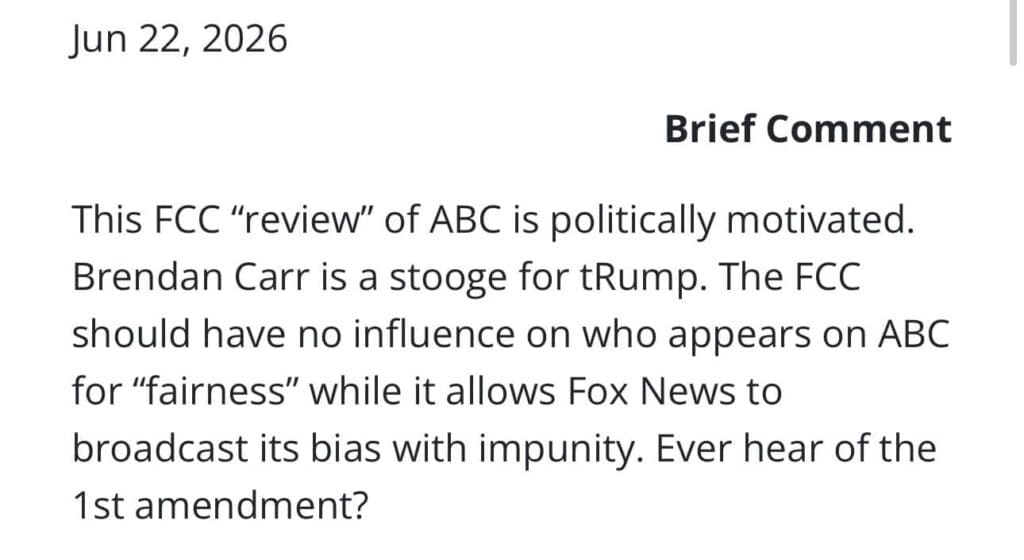
As I mentioned above, the Supreme Court prioritizes the viewers’ rights to the broadcasters’ rights of free speech. Accordingly, viewers play a unique role in the license renewal process. This is why The View took out ads asking its viewers to weigh in on this matter. The ad spot ends with a QR code that will take you to the FCC’s website, where you can submit your comments on why you believe ABC’s programming is beneficial to the public interest. If you want to leave a comment, you can simply click on the button on the right side of your screen called “+Submit an Express Filing.” I actually spent some time reading through some of the comments viewers have already left (like the one below) and I must say, it really restored some of my faith in humanity.
Parting Thoughts
I like The View and I enjoy Jimmy Kimmel’s blistering sense of humor. But, I’m not a die-hard fan of either. I’m also not a big fan of Disney. I’ve been to Disneyland only twice in my life and can’t recall the last time I watched a Disney-produced film. I’m a big fan of Shonda Rhimes, though, and to the extent her shows are aired on ABC (Grey’s Anatomy, Scandal), I’ll support them because I support her. In other words, I’m not going to run out into the streets with my hair on fire if I have to queue up Kimmel et al. on YouTube instead of on my TV.
What I do find troubling, though, is an observable pattern of government behavior that typically begins with an angry social media post by the President. The President posts an irate rant on Truth Social, and all of a sudden, the wheels are in motion. The DOJ, the EEOC, the FCC–they are all levers at Trump’s disposal and he yanks on them without thinking. In this situation, he has thrown himself at a formidable opponent. Anyone who has tangoed with Disney’s banc of lawyers knows they are in for a battle that will leave them bloody no matter who wins.
In recent months, we’ve seen CBS fall into the trap of censorship, but it doesn’t look exactly like the kind of censorship we might expect from places like North Korea (where watching Kdramas can get you executed). From far away, it merely looks like a new owner installing his cadre of producers and talent, while weeding out those he doesn’t like. But it’s important to keep in mind that the FCC, too, played a role in CBS’s current programming: it reopened an investigation into CBS when CBS needed as little hostile scrutiny as possible–during the Paramount-Skydance merger review. Recall, too, that just days before this merger was approved, Paramount settled its lawsuit with Trump by agreeing to pay him $16 million.
Thus, even if the FCC ultimately loses, Trump still wins. Because what happens when Trump targets a more vulnerable prey? Disney may well come out the victor in this fight, but what of all those who caved because they simply couldn’t afford to fight at all? Or all those who bent the knee because they didn’t share Disney’s conviction? Or the ones who decided their integrity wasn’t worth the headache?
This is how authoritarianism plants its seeds while no one is paying attention–not only when the Goliaths duke it out with one of Trump’s stooges, but when all the little guys wave the white flag. Whether it’s Disney, CBS, or the nameless affiliate broadcaster out in middle America, this type of pressure influences what we watch, and what we watch, what we listen to, what we “click on”–all of those things shape the conversations we have at the dinner table, at the water cooler, in Pilates class. And those conversations? They shape our thoughts and views, and our thoughts and views end up in the ballot box. And that ballot box translates directly into policy, and policy forms the foundation of power.
A healthy democracy is built on a single premise: power belongs to the people.
Which means we must remember: the people have the power to give it away.
Wishing you all the best,
-Joanne
Recent Newsletters


Will you run for office? We need you.
Thank you as always for your intellect on this and so many other relevant events. Sometimes you are the only source where I find out something important is happening. You weighing in helps keep me informed. And helps me understand how/when I need to dive in. Kris x