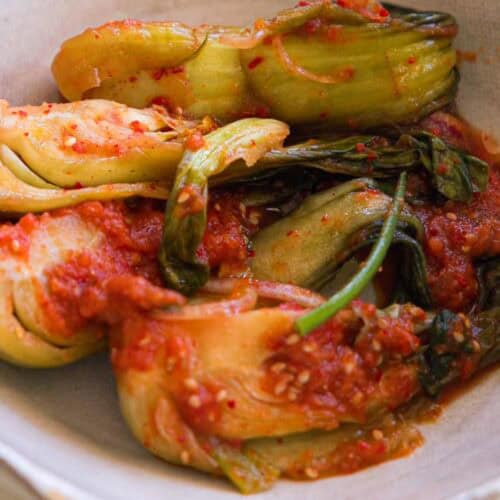
Baby Bok Choy Kimchi
This spicy, crunchy, and totally refreshing baby bok choy kimchi is so easy to prepare and can be enjoyed right away. BUT, it also tastes excellent with a few days of fermentation. This Bok Choy Kimchi is the perfect way to enjoy this summer green if Napa cabbage is harder to find or if you just enjoy bok choy!
Equipment
- 2 large bowls
- 1 blender
- 1 64 oz mason jar or airtight container
Ingredients
- 12 baby bok choy heads (1.3 kg)
- 2/3 cup course sea salt
- 4 tbsp granulated sugar
- 6 dried red chilis
- 1/3 cup fishy sauce
- 2 tbsp sweet white rice flour
- 1/2 cup onion (rough chopped)
- 1/2 cup Korean pear (or sweet apple or mix of both, rough chopped)
- 1/2 cup Korean radish (rough chopped)
- 6 red chili peppers (I used red jalapenos, but you can use serrano or, if you can get some, Korean "hong" gochu--trimmed and seeded)
- 1/2 cup red bell pepper (rough chopped)
- 6 scallion whites (trimmed and rough chopped)
- 1/4 cup garlic cloves (peeled and trimmed)
- 1 knob ginger
- 1/3 cup soju
- 4 tbsp plum syrup (or brown rice syrup, agave, etc.--check out substitutions section in blog post)
- 3 tbsp gochugaru
- 2/3 cup red onion (julienned)
- 6 scallion greens (sliced in half, lengthwise, so they're extra skinny)
- 2 tbsp toasted sesame seeds
Instructions
- First, make a small slit into the base of your baby bok choy (or adult bok choy) that is about 1 to 2 inches deep. Then, split them in half using your hands. For larger bok choy (even the baby ones), repeat to make quarters. Place them in a large bowl. Then, rinse them thoroughly. Dirt can get into those very tight crevices, so take your time with this step and really wash them. Dry them off with a kitchen towel and place them back in the large bowl.
- Add your dried chilies to a small bowl, together with the Fishy Sauce. This will rehydrate them for later.
- Stir together the salt and sugar with 6 cups of cold, preferably filtered water, until the salt and sugar are dissolved (just keep mixing until it dissolves--I learned this in science class!). Pour the brine over your bok choy. Flip them over several times to make sure they are all coated with the brine. Set the bok choy aside for 30 minutes. After 30 minutes, give the greens a few flips again, so they get a little "refresh" of brine.
- While your bok choy is soaking in the brine, make your rice paste by whisking together the sweet white rice flour together with 3/4 cup of water over medium-low heat. Continue stirring with a whisk or rubber spatula until it turns into a thick paste. Set aside and let it cool.
- Prepare the blended mixture or what I call the "sludge." First, using kitchen shears, cut up the rehydrated peppers into smaller pieces. Place the rehydrated peppers, together with the Fishy Sauce, the chopped (not julienned) onion, scallion whites, garlic, pear, radish, ginger, bell pepper, jalapeno, soju, and plum syrup into the blender and blend until smooth. Set aside or place in the refrigerator if your bok choy still has a long way to go.
- After one hour, the green parts of your bok choy will be quite wilt-y. The base of your bok choy will still be pretty hard, but because they aren't as hard or as thick as napa cabbage leaves, this is ok. If you're using adult bok choy, I'd let it sit for an additional 20 minutes. Once you've determined they are ready, bring them over to your sink and rinse each bok choy thoroughly. The general rule of thumb is to rinse each piece twice. Afterwards, dry them off thoroughly with a kitchen towel or let them air dry for another 20 minutes; otherwise, they will be too wet and will dilute the kimchi sauce.
- Prepare the kimchi sauce by adding your sludge, rice paste, gochugaru, julienned onions, and scallion greens into a large bowl. Mix the contents using a large wooden spoon or spatula until all components are evenly incorporated.
- Add about half the bok choy into the bowl containing the sauce. Using your hands, sauce the leaves of the bok choy, making sure the sauce gets as far into the crevices of the bok choy base as possible. Again, this is necessary not only to promote the fermentation of the thicker parts of the leaves, but to prevent molding or yeast growth. Place the sauced bok choy into your air-tight container (one that is not too big, as too much space on top may also cause mold growth). Sprinkle with sesame seeds. Repeat with remaining bok choy.
- Storing your bok choy kimchi is part of the recipe (and not just a separate question for leftovers), since how and where you store it will impact how long it takes to ferment. Place your bok choy in a 64 ounce mason jar or other equivalent container. Press down on the radishes to make sure you squeeze out any air pockets. The final layer of bok choy should be smothered in kimchi sauce and sprinkled with a tablespoon or two of salt (this will guard against the growth of yeast).
- Seal your container and leave it out at room temperature for one days. Then, place in the refrigerator. Your bok choy kimchi should be ready to enjoy after 2 to 3 days!
Nutrition
Calories: 159kcalCarbohydrates: 29gProtein: 4gFat: 2gSaturated Fat: 0.3gPolyunsaturated Fat: 1gMonounsaturated Fat: 1gSodium: 98mgPotassium: 261mgFiber: 5gSugar: 18gVitamin A: 9106IUVitamin C: 112mgCalcium: 260mgIron: 3mg
Tried this recipe?Let us know how it was!